
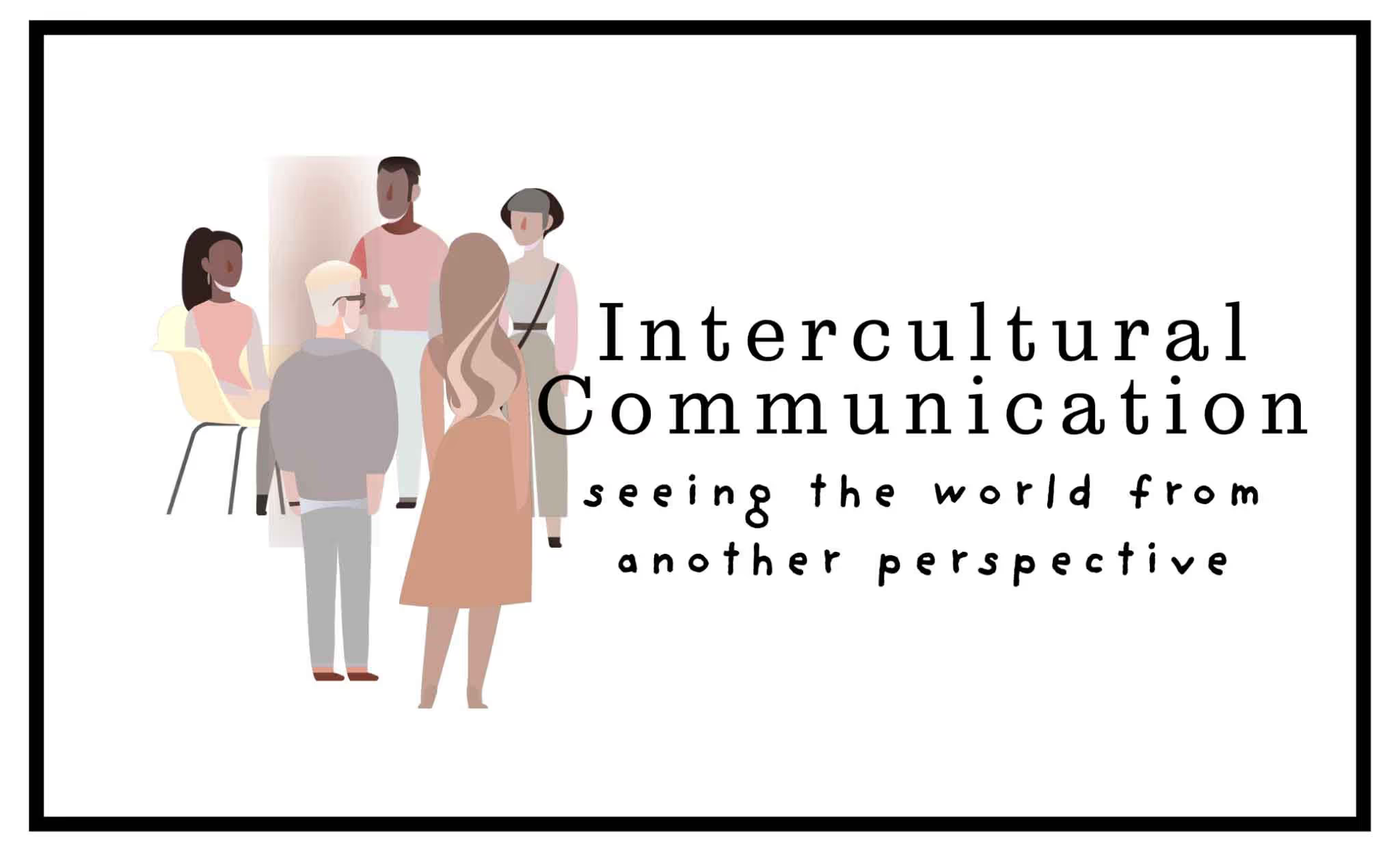
Intercultural Communication: Moving Beyond "Us vs. Them"
Seeing the world from a different perspective.
Teaching of Communication
COML 510 Communication Teaching and Pedagogy
Patti Hinman
Master's in Communication and Leadership
Elective Course
COML 518 Course Design and Implementation
Gonzaga University
Graduated Summer 2023
Developmental Model of Intercultural Sensitivity
As I began reading through Teaching Communication of Vangelisti, et al. I was thinking I would probably teach Rhetoric since I love philosophy, Plato, and Aristotle. But when I got to the chapter on Intercultural Communication, I knew that was the one. It is something that I have thought about and formed my own theories based on experiences with people in my own life.
With IC as my topic of choice, I set out to learn more about it. I have never taken a class on IC and needed a framework to understand it. I came across IDR Institute that does research on Intercultural communication.
What is Intercultural Communication?
The research of Intercultural Communication conducted by Milton Bennett at IDR Institute was immediately interesting to me, and seemed so relevant to the current environment we live in. The focus was more a shift in consciousness and understanding than learning details and differences about different cultures. The ability to understand not just culture as an entity but the humans that make up what we call culture.
The shift is from culture as a thing, to the humans that have a different reality. The idea here is not to compare cultures but see each human as someone to understand, as someone who might not share the reality I have, and to see the person as not wrong or different. Similarly, when you see a beautiful flower for the first time—taking time to look closely, notice the fragrance, notice the type of leaves, the color of the petals and the sepals, to admire the flower for its own sake, and come to understand its value because it is: it exists.
Introducing the Developmental Model of Intercultural Sensitivity
A framework to explain how people experience and engage cultural difference. The model assumes that as perceived cultural differences become more complex, one’s experience of culture becomes more sophisticated increasing competence in intercultural communication.
Theory:
The DMIS is a way to move from communicative competence in one’s own culture to competence across other cultures, with the assumption that dealing with otherness in complex ways is not a natural way of part of a culture’s adaptive strategy. Otherness exists as a vague concept and isn’t explored beyond recognizing superficial differences. Effective communication with people of other cultures is inadequate until one moves along the continuum from Ethnocentrism to Ethnorelativism. Moving toward Ethnorelativism is done though novel categories for otherness, much like realizing there is much more to coffee than just some brown grinds in a pod or poured into a paper filter. The variety of coffee plants are many, the environment coffee is grown in makes a world of difference in body, sweetness, acidity, and finish; similarly, cultures have their own environments that produce different people. Becoming a connoisseur of people and culture by recognizing their environment, their thought and feeling processes, their values, opens one up to complex personal experience of otherness. This is intercultural sensitivity identified by empathy and making meaning between cultures generates real intercultural value.
Disciplinary Grounding
According to Milton Bennett, denial, defense/reversal, and minimization are the stages of ethnocentrism in the DMIS, a model that individuals pass along a continuum as they develop greater sensitivity to cultural sensitivity to difference. As people come into contact with ethnicities different from their own, it could lead to a fight of flight response. These types of reactions to a new culture can result in inflicting harm on people, as we saw in the video “And We Stayed.” Cultural differences threaten the integrity of the world view of a person with a denial perspective, thus provoking a negative attitude. This threat to one’s reality and identity can develop the polarized view of “us” and “them”, and individuals may feel they must lose their own identity or feel as though their values and beliefs are threatened. Dennis O. Durocher, Jr. suggests students’ attitudes toward cultural differences is a pressing issue when learning a foreign language and can create a loss of interest in openness and prevent the student from the benefits learning a foreign language as well as culture.
Teaching students to be mindfully aware of their attitude towards foreign culture, and training individuals to recognize their own assumptions and values helps to move the student along the continuum of Bennett’s Developmental Model of Intercultural Sensitivity.
Experience
In Ignatian Pedagogy experience is a way to get a feel for what the learning is about. I will introduce the Developmental Model by using my coffee analogy. Many people drink coffee, but not everyone enjoys the variety of coffee, liking their particular way of drinking coffee. Other activities will be to sort objects based on some characteristics which will show there is really no right or wrong way to categorize the objects. Each experience will show differences in ways that minimize any threatening aspect by using symbols and not actual cultures. This allows the student to become familiar with the concept of difference in a nonthreatening way.
Reflection
In an online class much of the learning is done at a student’s own pace because it is asynchronous. A reflection will be asked for after the activities are complete. Also, students will post to a discussion form about the experience and comment on other posts. This is an opportunity to process thoughts and emotions, and share them with the class, then give feedback to others as well as getting feedback on their post. Depending on each student, there is much to learn from discussion board posts.
Action
In Ignatian Pedagogy action is a way to use the new knowledge in the world to get a sense of the impact that can be made. An idea for action could be a student could write their own “class” to help others to be culturally competent.
Evaluation
Presenting their action to the class would be a way to demonstrate they are meeting the objectives in the class.
Pedagogical Grounding
In COML 518, Course Design for Online Learning I was introduced to Ignatian pedagogy. Consideration of the learner’s context, who they are, what do they already know, what skills and what context must they already have mastered in order to be successful. The object here is to know what will need to be addressed, what preconceived notions they have about the topic, how motivated are they to learn the topic and how will their interest be piqued.
The course design will use the Ignatian pedagogical model of Experience-Reflection-Action-Evaluation.
Proposed Artifact
My artifact for this class will be a six-week intercultural/interpersonal communication course. The course is designed as an online course making it widely available for people to take on their own time. The course will provide students with experiential activities to reveal values and patterns of belief and behavior that are not normally considered or noticed in everyday life. The artifact will be an online class accessed on the Teachable platform and will also live on my website openowl.co
Diversity, Equity, and Inclusion
This project directly focuses on Intercultural Communication with the objective of promoting sensitivity in the learner to look on “difference” as a connection point, a way to get to know the other who is “different.” This can include differences in skin color, age, ethnicity, language, and more. By recognizing that individuals may see the world from different perspectives, we can take steps towards creating a more welcoming world for all.
Recent studies have shown that students studying a foreign language can sometimes develop a negative attitude towards the foreign culture. However, if we can recognize that our reactions to different cultures are often a product of our own conditioning, we can begin to see beyond our own perspective and gain a greater understanding and appreciation of other cultures.
Intercultural communication is crucial to the well-being of all individuals and a key component in creating a more humane world. By broadening our understanding of different perspectives and integrating our knowledge, we can take steps towards a world in which every person feels valued. (Durocher, 2007)
I believe intercultural communication is at the heart of well-being for all. It is when we as humans take the larger view of the world, see that our own lived experience is only one of billions of lives, and desire for all people everywhere to feel valued for who they are. That’s a monumental task and would encompass a paradigm shift from where we are today.
I want to see a world where humans act humanely to each other and with the natural world. The first step is intercultural communication, which I see as the desire to see and know beyond one’s own perspective to see and know multiple perspectives and standpoints. As Artificial Intelligence, social media, wars for land and space, the extinction of species of animals, birds, reptiles, and arthropods continue in our world, it will take all of us communicating, learning, understanding, and integrating our knowledge to create a world that every person feels is worth living in.
Well, that’s a huge ask! Can one online course change the world? Probably not. But my hope is to start a pebble rolling and eventually a landslide of change.
Ready to Transform How You Connect?
Contact me to discuss how we can work together to build bridges of understanding in your life, organization, or community.
Summary & Conclusion
Results
The result of my capstone project is an online class for intercultural communication. At this point I feel my project is very incomplete, but hopefully I will have it the way I want it before the very end.
Theoretical Grounding Examination
Theories considered in designing this course include Stanley Geertz’s idea of “webs of significance” (Griffin, 2019), Milton Bennett’s Developmental Model of Intercultural Communication, Adichie’s TED talk, “The danger of a Single Story,” Schwartz Theory of Basic Values and more.
Ethical Concerns
This project sets out to change the way people think about communicating with another person by drawing attention to the differences each human sees the world. The biggest concern for me is that I grew up in the United States, the most dominant country in the world in a place without much diversity. I think there are things I don’t understand very well and most likely I am unable to see them clearly, such as how a Japanese person may look at communication based on the deep collective perspective they have.
Technical Lessons Learned
I found it challenging to take Online Course Design from COML 518 and apply it to my class because of the limitations of the free version of Teachable. There are three components to an online class: the course design, course creation, and implementing it digitally in a Learning Management System. The course design has to match up with the Learning Management System to get the full content to work well.
Key Takeaways
I am passionate about Intercultural Communication, and I am keeping a notebook filled with my thoughts and impressions about conversations I have with people, so I know I’m on the right track. I will continue to build out the online course as I have envisioned it.
Future Iterations
Once I have the digital portfolio built out, I will continue to work on the class. I have so many ideas about how to construct it, but didn’t have much time to work on it directly.
Visual Storytelling That Captures the Soul
Photography is more than technical skill—it's about seeing deeply and revealing truth through imagery. I love nature and wildlife photography for the adventure of it. My work has been sold as fine art and featured in commercial buildings.

"Seeing with the Soul" - Florence, Italy

"Landing Gear" - Coeur d'Alene

"First Rays of Summer" - Coeur d'Alene
Unlock Your Potential Through Strategic Coaching

Drawing on my Master's in Communication and Leadership, combined with real-world experience in start-up tech, financial services, and business development, I offer coaching that bridges theory and practice. Whether you're navigating a career transition, developing leadership skills, or seeking to articulate your professional vision, I provide personalized guidance grounded in communication expertise and business acumen.
My Approach:
I believe in self-growth as a lifelong practice. My coaching philosophy centers on helping you discover your authentic voice, leverage your strengths, and develop actionable strategies that align with your values and goals.