
Communication: The Power to Move People
Hi, I’m Patti. I grew up in the awe-inspiring wonders of Coeur d'Alene , where nature, lakes, and mountains seamlessly merge. As a Coug graduate, I delved into Econ, Finance, and Stats.
Overcoming Lyme disease in New England transformed me, unleashing my creativity and innovation. This shift ignited my passion for capturing the beauty of nature and wildlife through photography.
Recently, I completed my Master’s in Communication and Leadership from Gonzaga University, with a captivating class in Florence, Italy. Connecting with people and fostering collaborations across differences is my greatest strength. I wholeheartedly embrace diversity and value individual uniqueness, while taking responsibility for successes and challenges.
Where Understanding Meets Connection

Philosophy of Teaching
Education is not being certain of what one knows, but a continual process of inquiry; a willingness to examine one’s own prejudice and see the world from another point of view.

Communication: power to move people
Communication is the heart of human existence; each one is an individual with an individual experience, yet we yearn for connection and understanding. Communication has the power to move people to love or fear.
Goals for Learning
Socrates said, let no day pass without discussing goodness, examining the self and others. Life without this sort of examination is not worth living.
The goal of education is to examine life and all things in it. Socrates discusses with Diatoma in Symposium why people seek goodness and love, to which Socrates responds, “for happiness.” Self-knowledge is the beginning of wisdom, the start of being educated in body, mind, and spirit.
The ultimate goal is happiness, and as Socrates finds out, happiness comes from pursuing goodness. Helping students examine themselves and ask, why do I want to communicate; how does communication help me pursue happiness? Answering these questions begins with idea of the whole person and the dignity of each person, followed closely by serving others of the community, and as part of that community, to recognize the incredible diversity and cultural differences, and then to honor the diversity in thought and speech. In agreement and disagreement, to be respectful.
Dewey’s idea that education isn’t preparation for life, it is the goal and the process of life as experience is constantly reconstructed, being life itself resonates deeply with me. I hope to continue my own education alongside the students I teach. I love how Tara Westover says education is not so much a state of certainty, but a process of inquiry.
The goal of Interpersonal/Intercultural Communication is for students to recognize culture is a set of values, attitudes, beliefs, prejudices, and social rules governing the behavior of a group of people. It can be challenging when these differ from person to person. The starting point is to clearly understand oneself, how one processes what they learn about another person, develops relationships, and handles the stress of interacting with people with a different world view.
Enactment of goals
Foremost in my mind is education is to improve the student’s life and I am collaborating with them to fulfill this goal. I have always believed that a happy brain is a smart brain, it’s a matter of neuroscience that we learn when we are processing through the prefrontal cortex. When humans are stressed the logical part of the brain is hijacked by the amygdala which hinders the ability to think clearly, reflect, analyze, evaluate and create, the higher order of learning in Bloom’s Taxonomy.
Students begin to see that everyone has had experiences that are not shared by most people, and those experiences form the knowledge and prejudice. We just don’t see that people are the way they are because of their experience in life, we are quick to assume they are bad or stupid, when they are acting just as they should based on their own life experience, and how that is multiplied many times with people who are from different continents and speak different languages and have different norms in their home communities.

My Approach to Communication
A teacher-led presentation to develop a conceptual understanding of communication, what influences the process of communicating with people from a different group. How one’s own reaction, such as anxiety, distraction, difficulty in understanding, effects the process of communication.

The Transformation That's Possible
Using personality assessments, such as principlesyou.com to better understand themselves and to see how they differ from others. Exercises to communicate something without words, talk about an experience that most people never have, talk about a family tradition, etc.
Interpersonal Communication That Transforms
Sometime in my life I realized how differently people think and communicate. As I read my papers and projects from the program, I see how they fit together as something I am passionate about.
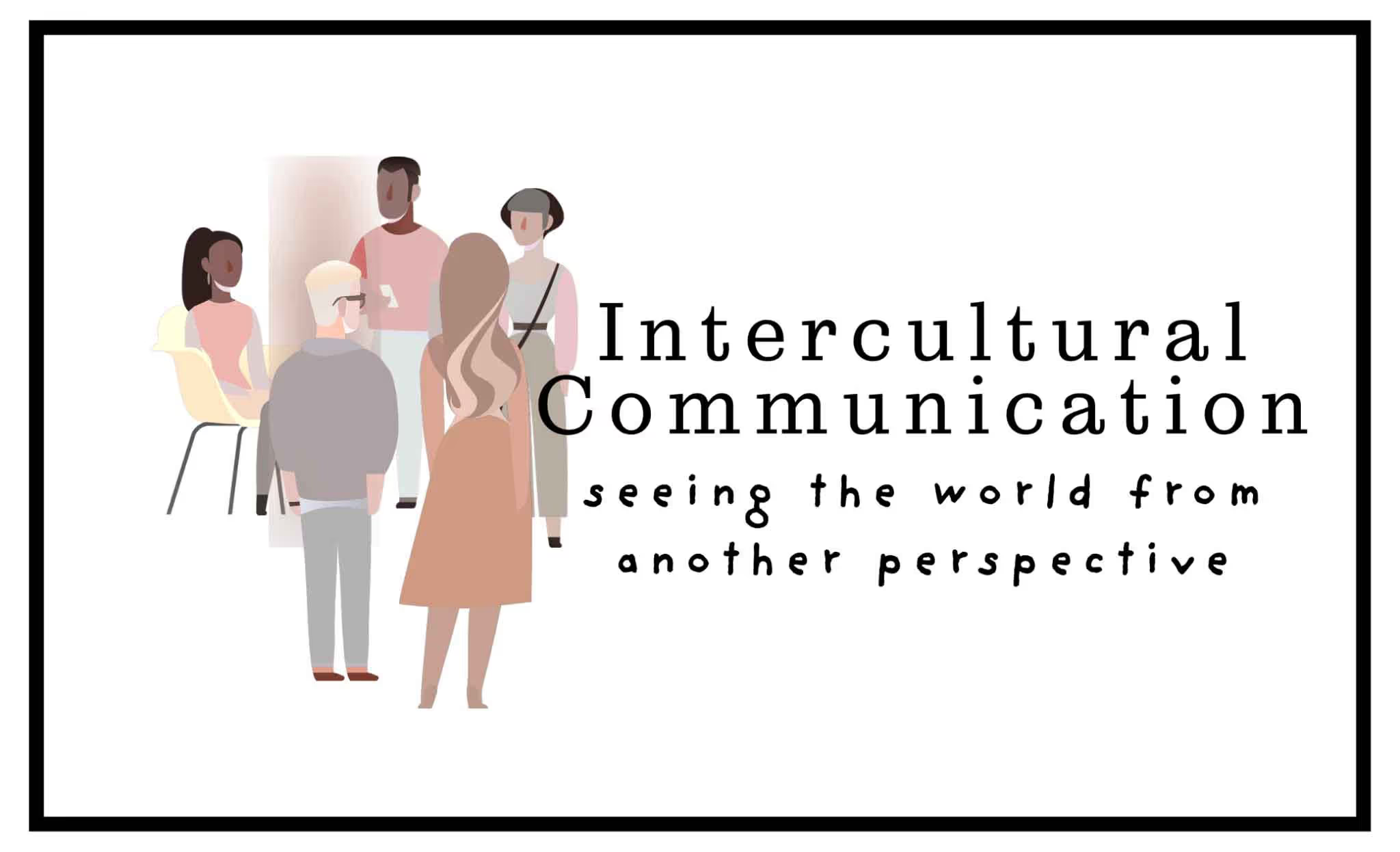
What is Intercultural Communication?
The research of Intercultural Communication conducted by Milton Bennett at IDR Institute was immediately interesting to me, and seemed so relevant to the current environment we live in. The focus was more a shift in consciousness and understanding than learning details and differences about different cultures. The ability to understand not just culture as an entity but the humans that make up what we call culture.
The shift is from culture as a thing, to the humans that have a different reality. The idea here is not to compare cultures but see each human as someone to understand, as someone who might not share the reality I have, and to see the person as not wrong or different. Similarly, when you see a beautiful flower for the first time—taking time to look closely, notice the fragrance, notice the type of leaves, the color of the petals and the sepals, to admire the flower for its own sake, and come to understand its value because it is: it exists.

Disciplanary Grounding: Research
The objective of this project is to create an online class that promotes intercultural communication and intercultural sensitivity to foster changes in the learner

Diversity Equity Inclusion
This project directly focuses on Intercultural Communication with the objective of promoting sensitivity in the learner to look on “difference” as a connection point
Ready to Transform How You Connect?
Contact me to discuss how we can work together to build bridges of understanding in your life, organization, or community.
Your Transformation Starts Here
Communication is the heart of human existence; each one is an individual with an individual experience, yet we yearn for connection and understanding. Communication has the power to move people to love or fear.

patti@digitalsocrates.ai
patti@openowl.co
Build Skills AI Can't Replace
Digital Socrates™ is a six week AI literacy course built for families, especially parents who want to guide their children to engage thoughtfully with AI tools, but is a tool anyone could use by Patti Hinman an AI Literacy Educator that bridges the gap between ancient wisdom and modern technology, giving your family the tools to thrive in an AI-powered world.

Visual Storytelling That Captures the Soul
Photography is more than technical skill—it's about seeing deeply and revealing truth through imagery. I love nature and wildlife photography for the adventure of it. My work has been sold as fine art and featured in commercial buildings.

"Seeing with the Soul" - Florence, Italy

"Landing Gear" - Coeur d'Alene